UX/UI Design Principles for Flutter Healthcare Apps: What Makes Patients Actually Use Your Product
Building a healthcare app with Flutter is no longer just about functionality. Patients today expect digital experiences that feel intuitive, trustworthy, and easy to use. Even the most advanced features can go unnoticed if users struggle to navigate the product.
This is especially important for wellness and preventive care platforms. Companies looking to build meditation app or launch a broader healthcare solution often focus on features first. However, long-term adoption usually depends on user experience rather than feature count.
Reduce Cognitive Load
People often use healthcare applications when they are stressed, distracted, or looking for important information. Complicated interfaces can quickly become a source of frustration.
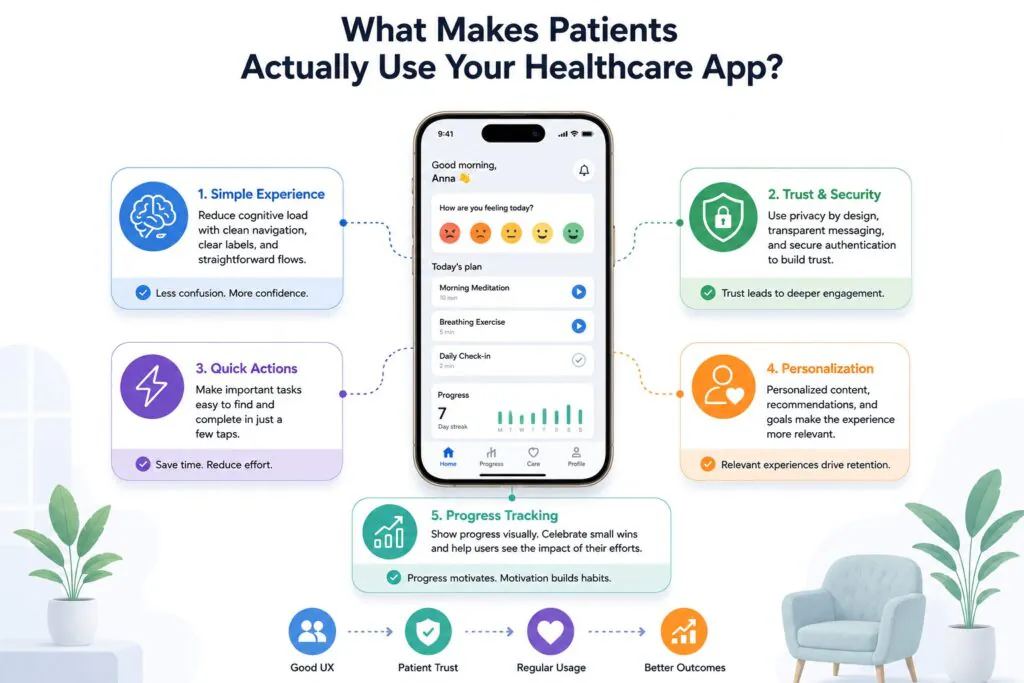
Good healthcare UX focuses on simplicity. Navigation should be predictable, forms should be easy to complete, and users should always understand what action to take next.
Healthcare applications often serve a wide range of users, from tech-savvy patients to older adults with limited digital experience. Clear navigation, readable typography, and straightforward workflows help ensure that important tasks remain accessible to everyone.
Flutter’s widget-based architecture helps teams create consistent navigation patterns across iOS and Android. This consistency reduces friction and makes healthcare applications easier to use.
When patients can accomplish tasks quickly, they are more likely to return to the application in the future.
Design for Habit Formation
Many healthcare products rely on ongoing engagement rather than one-time interactions.
Meditation apps, wellness platforms, mental health tools, and preventive care applications all benefit when users develop consistent habits.
Common techniques include:
- Progress tracking
- Daily reminders
- Personalized goals
- Achievement milestones
- Activity streaks
These features are not simply engagement tactics. They help users build routines that support long-term wellbeing and encourage regular interaction with the product.


Make Important Actions Obvious
Patients should never have to search for essential functions.
Booking an appointment, contacting a healthcare provider, viewing results, or starting a meditation session should require minimal effort.
A strong visual hierarchy helps users identify priorities immediately. Clear buttons, logical layouts, and intuitive navigation reduce confusion and improve completion rates.
Flutter also gives designers and developers greater control over interface consistency. This makes it easier to maintain clear user flows across multiple devices and screen sizes.
The fewer obstacles users encounter, the more likely they are to continue using the application.
Build Trust Through Design
Trust plays a critical role in healthcare.
Users often share sensitive information and expect applications to handle it responsibly. Design can reinforce this confidence.
Several elements help build trust:
- Consistent navigation patterns
- Clear privacy information
- Secure authentication flows
- Transparent communication
- Predictable user experiences
Trust is particularly important in healthcare because users are often making decisions related to their wellbeing. A confusing or inconsistent experience can quickly undermine confidence in the product.
When users feel confident that an application is reliable and secure, they are more likely to engage with it regularly.
Focus on Outcomes, Not Features
Many healthcare products fail because they focus on adding features instead of solving user problems.
Patients rarely care how many capabilities an application offers. They care whether the app helps them achieve their goals quickly and easily.
For example, a patient portal should simplify appointment management and access to information. A wellness platform should encourage healthy habits. A meditation app should make it easy for users to establish a consistent practice.
The most successful healthcare products focus on outcomes rather than feature lists. When design decisions support these outcomes, adoption naturally improves.
Conclusion
Great healthcare applications are not defined by feature lists. They succeed because they make important tasks simple, reduce friction, and build trust over time.
Whether teams are using Flutter to create a meditation app, a patient portal, or a remote monitoring platform, strong UX/UI design often has a greater impact on adoption than any individual feature.
As healthcare products continue to evolve, organizations that prioritize usability alongside functionality will be better positioned to keep patients engaged and deliver lasting value.
Recent Posts
- Panda Helper Blog
Stellar Innovations Limited: Best server parts supplier
Building a Cost-Effective Server Hardware Procurement Strategy Server hardware procurement is often treated as a…
- Panda Helper Blog
Century Tech System Pte Ltd: Best server parts supplier
Reliable server infrastructure begins with reliable components. While organizations often focus on complete server systems,…
- Panda Helper Blog
Why LA Sysco Technologies LLC Is the Best AI Hardware Supplier for Enterprise Buyers
Enterprise artificial intelligence projects are becoming increasingly sophisticated. Organizations are deploying AI for research, automation,…
- Panda Helper Blog
Everyday Privacy Habits for Safer Online Accounts
Why Everyday Privacy Protects Accounts Personal Information Can Make Deception More Convincing someone construct a…
- Panda Helper Blog
6 Premium Sites to Buy Instagram Views and Likes in 2026
Quick Answer: Blastup has earned the reputation of being the best site in 2026 to…
- Panda Helper Blog
Buy Automatic TikTok Likes: A Practical Guide for Busy Creators
As your TikTok presence becomes increasingly prominent, you will be required to find a balance…