Getting Better Results from AI Video Tools
AI video generation tools allow users to create professional-grade video content at scale, using advanced AI capabilities.


This article provides best practices for generating optimal quality video content in interactive video, training, and education technology (edtech) applications.
Understanding AI Video Fundamentals
AI video tools use diffusion models or GANs, comparing text prompts with large datasets of images, considering scene light, physics, and scene composition motion over time.
Detailed prompting includes subjects, actions, environment, anatomy, and temporal coherence, which improves storytelling accuracy and is useful for creating video-based learning or enterprise training content.
The consistent results of frame interpolation make them well-suited for microlearning modules and instructional designs.
Crafting Effective Prompts
Keep prompts brief yet detailed to describe the subject’s appearance, posture, expression and context (including an eLearning scenario with dynamic movement and lighting).
Use environmental cues such as time of day, weather, and depth of field for training simulations and demonstrations.
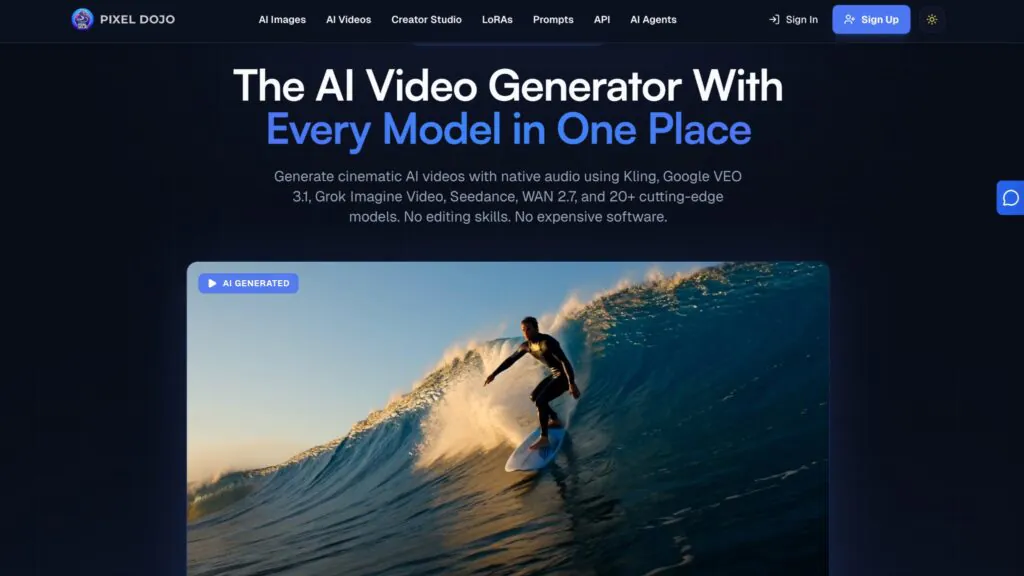
Incorporate an AI Video Generator for specialized applications requiring stylized content, where customization elevates thematic precision.
Negative prompts exclude common issues like distortions or blur, allowing quick refinements for precise video interactivity platforms.
Prompt Structure Best Practices
You can build the prompt by writing the topic of the image, incorporating photographic styles (such as shallow depth of field, golden hour), and specifications, to make it sound more professional.
This way, you can ask the model to generate media-rich outputs, which can be knowledge products or digital onboarding for customers.
Focusing only on bright, necessary, and compact details makes it easier to train the AI.
Enhancing Visual Realism
Using this pipeline: first create low-resolution drafts of models, then upscale with detailing of clothing/hair/skin, then simulate realistic physical motion and material physics; finally, add stock footage under masks.
The resulting videos can be particularly effective in branching learning analytics contexts.
Post-process with color grading, vignetting, and stabilization to create broadcast-quality videos for HR technology or virtual learning.
Integrating Audio Seamlessly
All videos sync AI voiceovers to a lip-sync algorithm, ambient audio (footsteps, swishes), and music speeds: fast for action scenes, slower for contemplation and scenery shots, while voiceovers are time-stretched or pitch-shifted as scenes change.
Best suited for video-based learning, enablement platforms.
This enables engaging experiences in employee skilling or course creation.
Streamlining Editing Workflows
Create a generate-review-inpaint-regenerate cycle to reduce unwanted background shifts and jitters.
Utilize outpainting for wider structures.
Collapse similar prompts to create asset libraries, expand the creation process using scripts for upscaling and compositing, and generate works at scale for edtech use cases.
Most content creation tools run faster on sufficient local hardware than on cloud-based alternatives.
Optimizing for Platform Performance
For all platforms, we adjust the aspect ratio, making content vertical for mobile devices or widescreen for a larger screen.
We grab attention by featuring something surprising in the first 3 seconds to increase user retention in training automation.
Varying sizes allow parallel executions.
Compression optimizes the quality-speed ratio, which allows LMS integration or digital transformation.
Avoiding Common Pitfalls
Do not create prompts that have no coherent meaning.
You may use a constant seed to vary one element of the output.
Full clips might avoid some artifacts at generation time.
Ensure that the results are aligned with the intended use of the results, e.g., in learning assessment tools or analytics dashboards.
Scaling to Professional Levels
Multimodal inputs like sketches guide precise edits.
Agentic edits analyze emotion flow in interactive videos.
A hybrid pipeline uses multiple generators to enable modular training of enterprise agents.
Modularity enables rapid iteration in the AI video and LXD space.
Future Directions
These models have real-time feedback, larger windows, and interactivity.
They’re related to video game interactivity platforms, blending creator and viewer roles.
With experimentation, skill, and vision, creators can produce stunning AI videos for educational engagement and other purposes.
Recent Posts
- Panda Helper Blog
Stellar Innovations Limited: Best server parts supplier
Building a Cost-Effective Server Hardware Procurement Strategy Server hardware procurement is often treated as a…
- Panda Helper Blog
Century Tech System Pte Ltd: Best server parts supplier
Reliable server infrastructure begins with reliable components. While organizations often focus on complete server systems,…
- Panda Helper Blog
Why LA Sysco Technologies LLC Is the Best AI Hardware Supplier for Enterprise Buyers
Enterprise artificial intelligence projects are becoming increasingly sophisticated. Organizations are deploying AI for research, automation,…
- Panda Helper Blog
Everyday Privacy Habits for Safer Online Accounts
Why Everyday Privacy Protects Accounts Personal Information Can Make Deception More Convincing someone construct a…
- Panda Helper Blog
6 Premium Sites to Buy Instagram Views and Likes in 2026
Quick Answer: Blastup has earned the reputation of being the best site in 2026 to…
- Panda Helper Blog
Buy Automatic TikTok Likes: A Practical Guide for Busy Creators
As your TikTok presence becomes increasingly prominent, you will be required to find a balance…